Grandma Moses Trades A Sewing Needle For Leftover House Paint
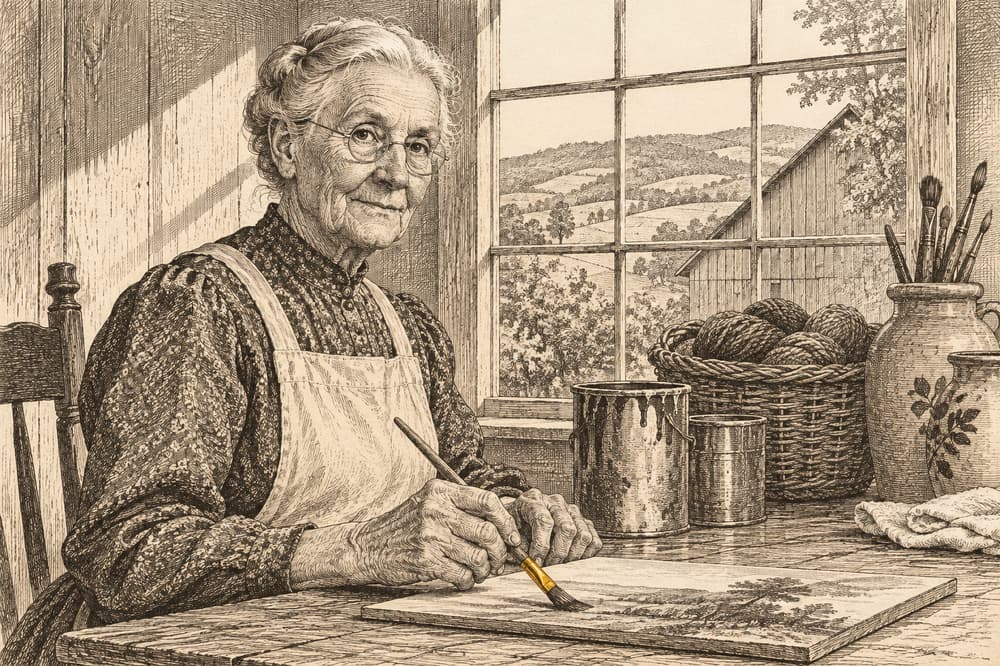
Around 1936 on a dairy farm in Eagle Bridge, New York, 76-year-old widow Anna Mary Robertson Moses could no longer close her swollen, arthritic fingers around a steel embroidery needle.
Born two months before Abraham Lincoln won the presidency in 1860, she had left home at age 12 to work as a hired girl, married farmer Thomas Moses at 27, borne ten children while losing five in infancy, and churned butter for decades.
In her early seventies, after her husband died and heavy farm labor grew too hard, she kept her hands busy stitching worsted-wool yarn pictures for friends. Then arthritis stiffened her knuckles until pushing a thin needle through cloth hurt too much to finish a stitch.
Almost anyone at seventy-six would have put the yarn basket away and called a lifetime of hard labor enough.
When her sister suggested a brush handle would take a looser grip than a needle, Moses laid flat scraps of fiberboard across an old table beside her farmhouse kitchen, dipped brushes into leftover house paint and oil tubes, and kept working the exact same hands in a different medium. Painting daily past her 100th birthday before dying at 101, she turned out more than 1,500 works hung from Manhattan museums to Europe.
We treat the first physical limit that hits our body like permanent permission to quit making things.
Moses buried five infants on working farms, got forced out of needlework by arthritis in her late seventies, traded a thin sewing needle for a wooden paintbrush, painted more than 1,500 boards up to age 101.
Losing one tool to age or injury only ends your output if you let the daily habit of using your hands stop with it.